
How Mugs Are Printed: Sublimation Explained
Ever wondered how the artwork on a ceramic mug ends up so crisp, colourful and dishwasher-resistant? The answer, more often than not, is sublimation printing. It sounds fancy - and to be fair, it is quite clever - but it’s also the industry standard for quality printed mugs. Here’s how it works (in plain English) and why it matters.
What Is Sublimation?
Sublimation is a printing process that uses heat to transfer dye directly into a specially coated surface — in this case, a ceramic mug. The dye turns into gas without becoming liquid first (that’s the “sublime” bit), and bonds with the coating on the mug itself. The result? A vibrant, permanent image that won’t peel or scratch off.
It’s not a sticker. It’s not paint. It’s chemistry.
It’s not a sticker. It’s not paint. It’s chemistry.
The Process, Step by Step
1. Design Printed on Transfer Paper
The image (usually in reverse) is printed using sublimation ink on a special transfer sheet.
2.Wrapped Around the Mug
The transfer sheet is carefully wrapped around a polymer-coated ceramic mug.
3.Heat Pressed
Using a heat press (around 180–200°C), the ink is vaporised and embedded into the mug’s surface.
4.Cooled and Checked
The paper is removed, and what’s left is a sharp, full-colour design — smooth to the touch and fused into the glaze.
The image (usually in reverse) is printed using sublimation ink on a special transfer sheet.
2.Wrapped Around the Mug
The transfer sheet is carefully wrapped around a polymer-coated ceramic mug.
3.Heat Pressed
Using a heat press (around 180–200°C), the ink is vaporised and embedded into the mug’s surface.
4.Cooled and Checked
The paper is removed, and what’s left is a sharp, full-colour design — smooth to the touch and fused into the glaze.

Why Sublimation Is Ideal for Mugs
● Durability: The print won’t crack, fade, or peel — even after hundreds of washes.
● Detail: Fine lines, vibrant colours, and photo-level sharpness are all possible.
● Speed & Consistency: It’s efficient for both one-offs and bulk printing, with consistent quality.
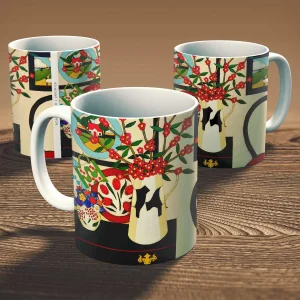
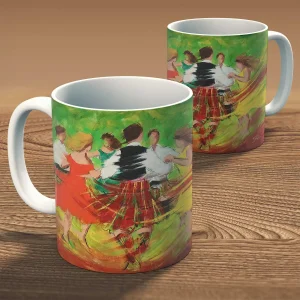
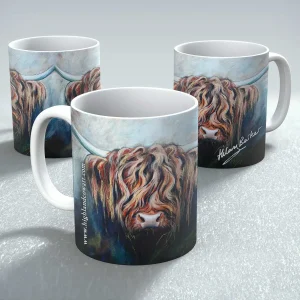
It’s how we get detailed Scottish artwork onto mugs without losing quality — the kind you’ll find across our ceramic mug range.
● Detail: Fine lines, vibrant colours, and photo-level sharpness are all possible.
● Speed & Consistency: It’s efficient for both one-offs and bulk printing, with consistent quality.
It’s how we get detailed Scottish artwork onto mugs without losing quality — the kind you’ll find across our ceramic mug range.
Are There Any Downsides?
Aye, a couple:
● Sublimation only works on mugs with a polymer coating - so not every ceramic mug can be printed this way.
● It’s best suited to light backgrounds, as the inks are translucent and don’t show well on dark colours.
Still, for most printed mugs in everyday use, sublimation is the best in class. It's the reason your favourite mug still looks sharp after years of brewing and dishwashing.
Curious about how to care for sublimation mugs or what size to pick? Our Mug Buyer’s Guide: Ceramic Edition has everything you need to know — no jargon, no fuss.
● Sublimation only works on mugs with a polymer coating - so not every ceramic mug can be printed this way.
● It’s best suited to light backgrounds, as the inks are translucent and don’t show well on dark colours.
Still, for most printed mugs in everyday use, sublimation is the best in class. It's the reason your favourite mug still looks sharp after years of brewing and dishwashing.
Curious about how to care for sublimation mugs or what size to pick? Our Mug Buyer’s Guide: Ceramic Edition has everything you need to know — no jargon, no fuss.